My favorite John Oliver anecdotes

Below are some anecdotes of John Oliver that I remember fondly. My formal tribute to John Oliver is published on the MIT web site, along with those of my colleagues.

* * *

Early in my TFC career, John approached me during a rehearsal break. “May I get your opinion on something?” he asked, pulling a carefully folded paper from his pocket. I panicked inside, assuming he was going to test his “newbie” with a musical question. Much to my relief and surprise, John showed me an advertisement for a 3-in-1 printer/scanner/copy machine. “That will be really useful to have in the office! And such a space saver,” I offered with far too much enthusiasm. “Good! I thought so,” John said, as he tucked the paper away back in his pocket.

* * *

One time in the Symphony Hall basement, I passed John on his way to the vending machines, and he asked if I had change for a two or a five. “A two?” I asked. “I always ask for two-dollar bills at the bank. That’s how they remember me,” he said.

* * *

Many years ago I had a coaching with John Oliver. At the end of the coaching, I asked how much I owed him for his time. He had already started walking from the piano back to his office and without turning around or pausing he said, “Nah, you’re family.”

* * *

(I guess technically this is an anecdote about me, but anyway.) Whenever people talk about how nobody reads print newspapers anymore, I always chime in, “Actually John Oliver buys four papers every morning!”

* * *

During a rehearsal of Bach’s Singet dem Herrn, John stopped the chorus, dissatisfied with the sound. “Don’t sing with your special Bach voices. Sing with the voice God gave you,” he said. These words of wisdom have become a personal motto for many of us.

* * *

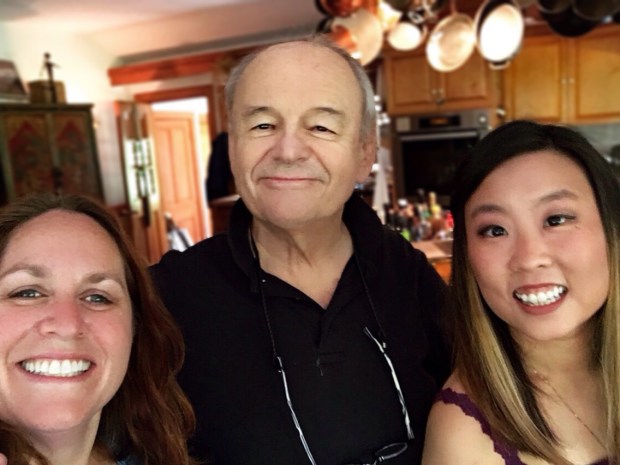
July 26, 2017 was the last time I saw JO. I visited him with my friend and TFC “stand-mate” Jeni Cameron, and he was in such high spirits. In his living room, he had a framed “Missing Dog” flyer. He knew neither the owner nor whether they found the dog, but he thought the dog was cute! He told us about his friend Jim’s grandchildren and how kids were “the most astonishing thing,” a phrase he’d previously used only to describe great music and singers. He showed us pictures from the time Jim dressed him up in motorcycle gear and took him for a ride up and down the street. And, of course, he told stories about Leinsdorf, Lenny, Seiji, and Phyllis, all of which we’d heard before but were happy to hear again. Oh, what I would give to hear those stories again…I miss you, JO.
JO_072617

Weepy Ninth closes BSO season at Tanglewood

funion

Weepy Ninth closes BSO season at Tanglewood

LENOX — Sunday’s performance of Beethoven’s Ninth Symphony marked the end of John Oliver’s 45-year career with the Boston Symphony Orchestra. Oliver received the Tanglewood Medal in recognition of his preparation of more than 200 works and 500 rehearsal jokes for well over 1,000 performances.

Punctuated by heaving sobs and the occasional honking nose, the fourth movement of the symphony took on a morose atmosphere despite the text’s call to joy. Even chorus choreographer Anna Choi looked unusually serious. The Tanglewood Festival Chorus sang from memory as usual, keeping their hands free for fistfuls of kleenex and blowing kisses towards Oliver’s seat in the audience. At times, their signature “fully-throated” sound was blubbery and downright mucousy.

Naturally, the chorus pulled it together to execute the final fugue flawlessly.

The orchestra played admirably during the prior three movements, but truth be told, no one was really paying attention until the chorus stood up. The historic performance, which sparked an ovation lasting well into Monday morning, will be remembered for its passion and the tremendous achievements of its honoree, John Oliver.

Reflections on Rafael Frühbeck de Burgos

Last summer, the Tanglewood Festival Chorus and PALS children’s chorus performed Mahler’s third symphony with Maestro Rafael Frühbeck de Burgos. After one of the rehearsals, John Oliver addressed the children. They listened attentively, perhaps expecting one of his usual quips, but John had something serious to say:

Kids, I want you to watch this conductor carefully. He’s very old — older than they say he is, which is 80.

The kids’ eyes widened while the adults chuckled. John continued.

His health isn’t as good as it once was, but when he’s conducting, he comes alive. Music is what keeps him going. Some of you will find, as you get older, that music is what keeps you going too.

This story came to mind when I learned of Rafael’s death, a week after he announced his retirement. He lived to make music until his body would no longer allow it, and what glorious music it was.

My favorite performance with Rafael was Beethoven’s ninth symphony, a piece I’ve heard and performed so many times, I almost take it for granted. Usually during the third movement, the slow one, my mind starts to wander. My bottom has started to go numb, the temperature on stage is too hot, and the bugs are creeping me out. But that year, I was awestruck when the third movement began. The strings produced a sound so exquisite, even in their consistent greatness, I’ve yet to hear it again. It was one of those tingle-inducing moments when I knew, too, that music is what keeps me going.

Last week, the BSO and TFC dedicated the Verdi concert to Rafael, who was originally to have conducted the performance. But in our hearts, many of us sang for him the night before during Mahler’s “Resurrection” Symphony, a much beloved piece for a much beloved conductor. Was entstanden ist, das muss vergehen! Was vergangen, auferstehen! What has come into being must perish! What has perished must rise again!